
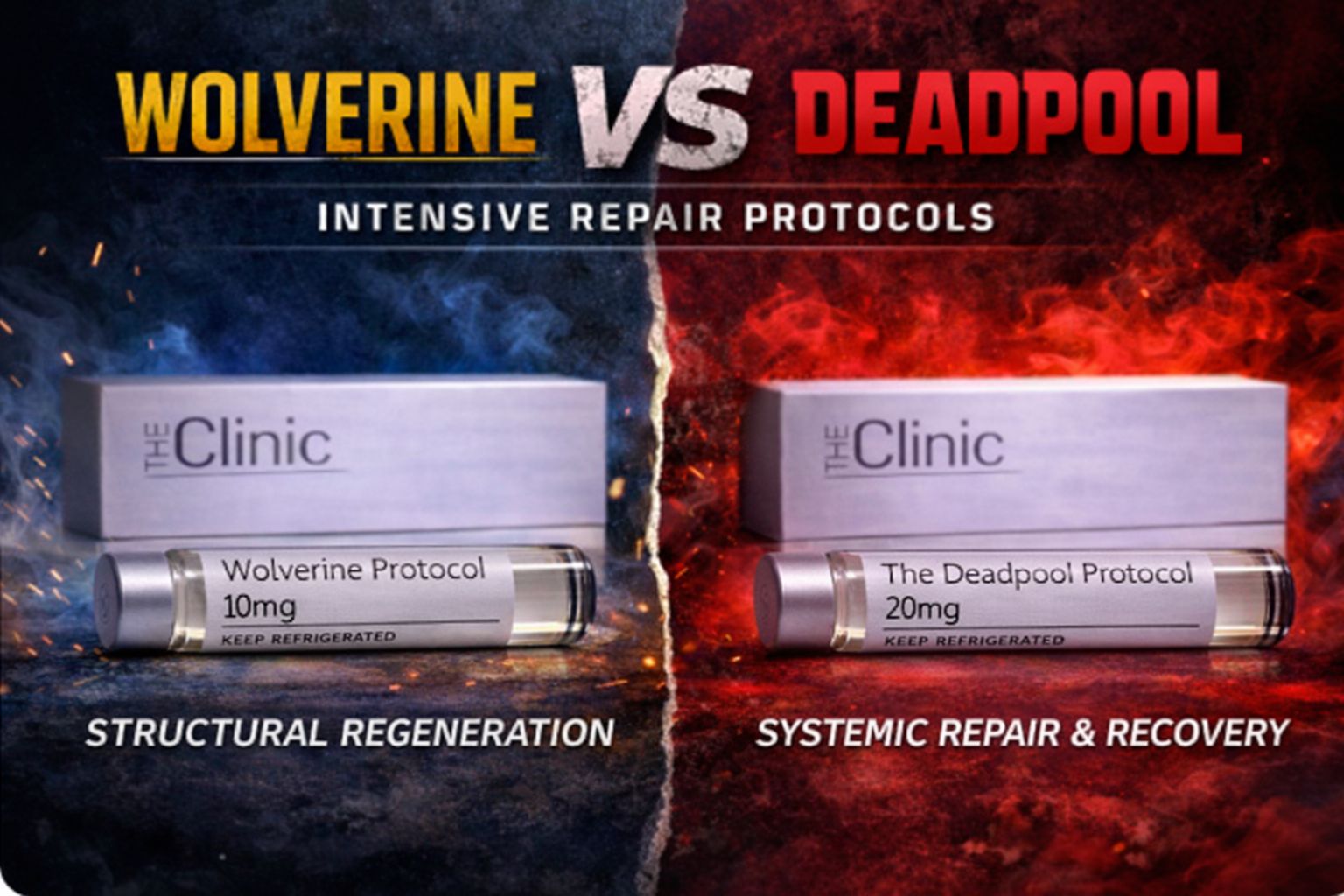
Regeneration is not a single pathway — it is a coordinated biological system. Tissue repair depends on signaling cascades, structural remodeling, inflammatory regulation, vascular adaptation, and immune balance working together in sequence. At The Clinic, we do not assemble stacks randomly or follow trends. Every formulation is engineered around biological context and repair strategy.
That is why both Wolverine Stack and Deadpool Stack exist within our regenerative framework. They are not variations of the same concept. They are strategically distinct protocols designed for different physiological environments and different stages of recovery. Understanding the difference changes how you deploy them.
The Limits of One-Dimensional Repair
Many recovery strategies focus purely on stimulation: increase collagen production, enhance fibroblast activity, accelerate angiogenesis. While these mechanisms matter, stimulation without regulation can create friction. Excess inflammatory signaling disrupts collagen organization. Chronic cytokine activity reduces tendon resilience. Immune imbalance prolongs tissue sensitivity and slows structural consolidation.
Intelligent regeneration must account for both forward remodeling and environmental stability. This is where the Wolverine Stack and the Deadpool Stack diverge.
Wolverine
Focused Structural Regeneration Under Load
The Wolverine Stack is built to drive connective tissue adaptation. It is designed for environments where inflammation is controlled and the objective is rebuilding strength, density, and mechanical resilience. It emphasizes forward remodeling pressure and assumes the terrain is stable and ready to adapt.
Wolverine is deployed when the goal is performance acceleration and structural strengthening.
- Connective tissue strengthening during heavy training blocks
- Increasing tendon and ligament density
- Accelerating return-to-load phases
- Structural adaptation after rehabilitation is complete
- Performance rebuilding in stable biological systems
In practical terms, Wolverine fits when inflammation is low, tissue integrity is intact, and mechanical load is increasing. Wolverine builds forward. It prioritizes adaptation under pressure.
Deadpool
Integrated Maximal Repair and Environmental Control
The Deadpool Stack was engineered for a different biological reality. It combines systemic regeneration signaling, structural repair amplification, and inflammatory modulation into one coordinated strategy. The inclusion of KPV fundamentally shifts the purpose of the stack.
This is not simply about stimulating tissue repair. It is about optimizing the terrain in which repair occurs. Deadpool is particularly powerful when inflammation is present, recovery is inconsistent, or the system is under stress.
- Post-surgical soft tissue recovery
- Active tendon and ligament rehabilitation
- Chronic inflammatory environments
- Individuals with repeated flare-ups
- Recovery phases that stall despite stimulation
- Structured return-to-training after tissue trauma
In practical terms, Deadpool fits when inflammation is elevated, tissue is reactive under load, and healing must occur without inflammatory escalation. Deadpool does not reduce intensity — it integrates intensity with control.
Why Deployment Context Matters
Choosing between the Wolverine Stack and the Deadpool Stack is not about strength. It is about timing.
In structured regenerative programming, the stack selection often follows a phased sequence:
- Early phase: stabilize inflammation, regulate signaling, rebuild intelligently — Deadpool
- Progressive phase: reinforce structure, increase load tolerance, accelerate adaptation — Wolverine
This phased approach aligns regeneration with biological readiness. That is The Clinic methodology.
Which Stack Is Right For You?
Choose Wolverine if:
- You are structurally stable
- Inflammation is minimal
- You are increasing training load
- The objective is strength and connective tissue density
Choose Deadpool if:
- You are post-operation
- You are in active rehabilitation
- You experience chronic inflammation
- Recovery stalls or flares under load
- The system requires stabilization before progression
The Recovery Protocol
Recovery is not random. It is programmed. The most advanced protocols do not simply stimulate tissue. They regulate the terrain, reinforce structure, and escalate adaptation in phases.
The Wolverine Stack and Deadpool Stack are not competitors. They are calibrated responses to different biological states. When deployed correctly, they redefine what recovery looks like.