
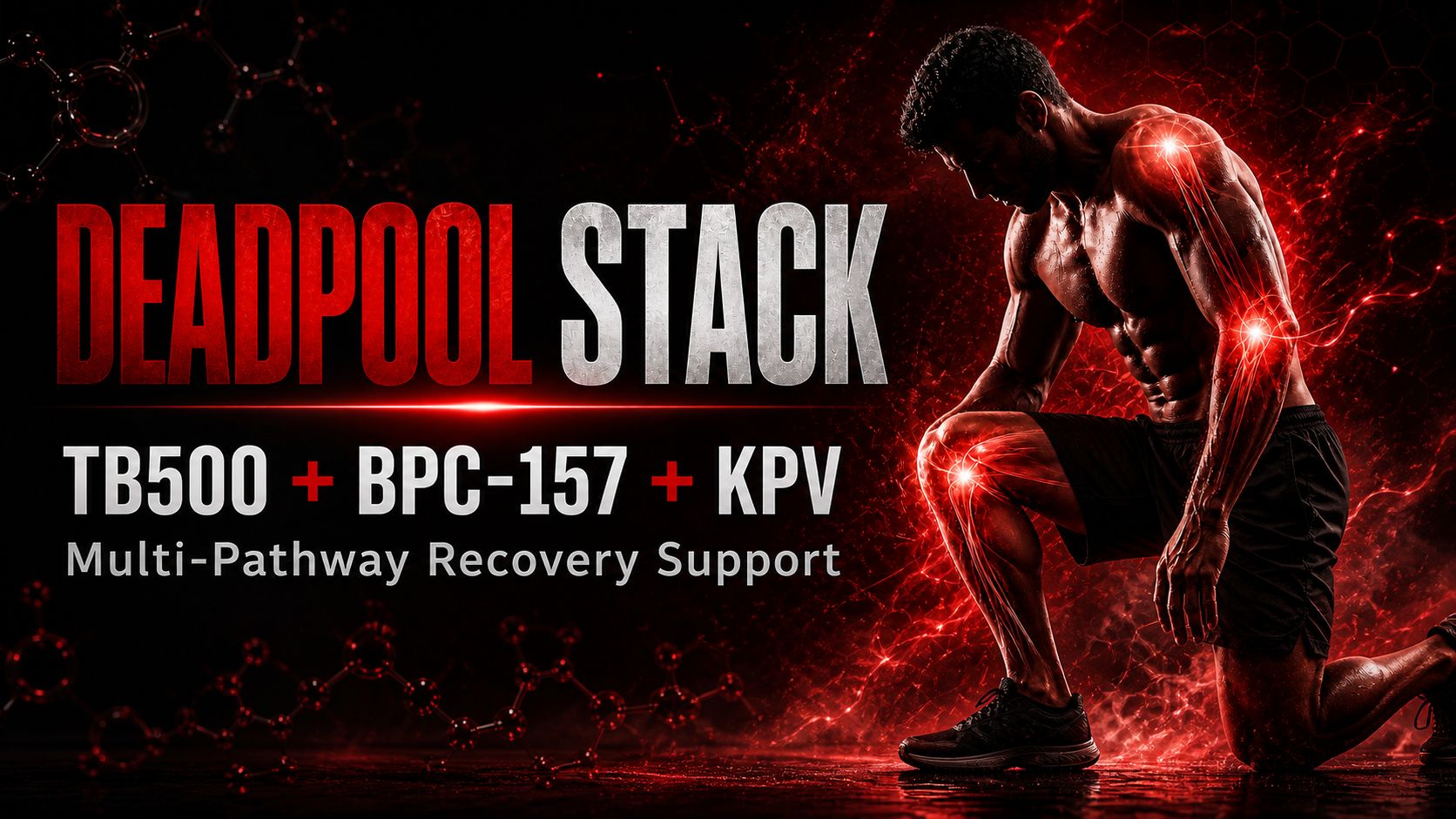
Recovery is rarely limited to one pathway. When tissue is irritated, overloaded, or slow to recover, the issue is often not only structural damage. Recovery also depends on the repair environment, inflammatory balance, blood-flow support, tissue remodelling, and how well the body tolerates progressive loading.
The Deadpool Stack combines TB500, BPC-157, and KPV in one structured recovery formula designed to support three key areas:
systemic repair-environment support
connective tissue and structural recovery support
inflammatory regulation support
This makes the stack especially relevant during rehabilitation phases, connective tissue recovery, heavy training blocks, joint stress, soft tissue irritation, and recovery periods where comfort, tissue quality, and resilience matter together.
What Is the Deadpool Stack?
The Deadpool Stack is a multi-pathway recovery formula built around three complementary peptides.
TB500 supports the broader repair environment and tissue remodelling process.
BPC-157 supports structural tissue and connective tissue recovery.
KPV supports inflammatory balance and a calmer recovery environment.
Single-peptide protocols can be useful, but recovery often involves more than one pathway. A tendon, ligament, joint, or overloaded muscle may need support for repair signalling, inflammation control, tissue remodelling, and mechanical tolerance at the same time.
That is where a coordinated stack can make more sense than relying on one peptide alone.
Why This Stack Is Different
The Deadpool Stack is designed around a broader recovery model.
Instead of focusing on one isolated effect, it brings together three recovery-support roles:
TB500 supports the broader repair environment.
BPC-157 supports structural tissue recovery.
KPV supports inflammatory balance.
This combination makes the stack especially useful when the goal is not simply to calm an irritated area, but to support better recovery quality during a structured regeneration phase.
It is designed for people who want more than short-term comfort. The aim is to support the conditions that allow tissue to recover, remodel, and tolerate progressive loading more effectively.
How It Works
TB500: Systemic Repair-Environment Support
TB500 is the broad repair-support component of the stack.
It is commonly associated with tissue remodelling, cell migration, angiogenesis-related repair processes, and recovery-environment support. In this formula, TB500 is included to support the wider conditions under which tissue recovery takes place.
This makes it especially useful where the goal is not only to support one irritated area, but to improve the overall repair environment around training stress, connective tissue strain, or recovery demand.
BPC-157: Structural Recovery Support
BPC-157 adds the structural recovery side of the formula.
It is commonly discussed for tendon, ligament, muscle, myotendinous junction, gastrointestinal, and connective tissue support. In the Deadpool Stack, BPC-157 is included for people who want additional support during loading, remodelling, and tissue recovery phases.
Where TB500 supports the broader repair environment, BPC-157 helps reinforce the structural side of recovery.
This makes it particularly relevant during connective tissue recovery, tendon and ligament irritation, muscle strain recovery, and phases where tissue needs to rebuild tolerance under controlled load.
KPV: Inflammatory Regulation Support
KPV adds the inflammatory balance component.
Recovery can become less efficient when inflammation is excessive, prolonged, or poorly regulated. Inflammation is part of the normal repair process, but when it remains elevated for too long, it can interfere with comfort, movement, and consistent rehabilitation.
KPV is included to help support a calmer recovery environment.
Its role in the Deadpool Stack is to support inflammatory balance so the body can move more effectively from irritation into repair and remodelling.
How the Three Work Together
The strength of the Deadpool Stack is not that it does one thing. It is that it supports the recovery process from three angles at once.
TB500 supports the broader repair environment.
BPC-157 supports structural tissue recovery.
KPV supports inflammatory balance.
Together, this creates a more complete recovery framework aimed at supporting connective tissue resilience, tissue remodelling, joint and soft tissue comfort under load, tolerance to mobility work, and better recovery quality during heavy training or recovery blocks.
This is why the stack is especially relevant where tissue is not recovering as well as expected, or where the same area keeps becoming irritated under load.
Best Use Cases
The Deadpool Stack is best suited to structured recovery phases where tissue quality, comfort, and resilience need to improve together.
It may be useful during tendon and ligament recovery blocks, muscle strain recovery phases, joint stress from high-load training, shoulder, elbow, knee, or hip overload patterns, connective tissue remodelling phases, high-volume training periods, structured rehabilitation, mobility work, and post-procedure soft tissue recovery support where appropriate.
It is especially relevant for people who feel that tissue remains irritated too long after training, movement is possible but recovery quality is poor, stiffness keeps returning under load, or the goal is to rebuild tolerance rather than simply mask symptoms.
Practical Recovery Example
A useful way to understand the Deadpool Stack is to think of someone working through a persistent shoulder, elbow, knee, or tendon issue.
The area may not be fully injured, but it is not recovering properly either. It may tolerate movement for a while, then become irritated again under load. Mobility work helps, rest helps temporarily, but the same recovery limitation keeps returning.
In that type of recovery phase, the goal is not just comfort.
The goal is to improve the repair environment.
The goal is to support the tissue response.
The goal is to reduce inflammatory drag.
The goal is to rebuild tolerance gradually.
The goal is to support better recovery quality over time.
That is where the Deadpool Stack fits best.
It should not be positioned as an overnight fix. It is better understood as a structured support tool used alongside sensible loading, mobility work, rest, and recovery planning.
What People May Notice
The strongest way to frame outcomes is as recovery support over time, not dramatic guaranteed results.
Some people may notice improved recovery feel, less stiffness under load, improved comfort during mobility work, better tolerance to rehabilitation-style movement, improved joint comfort under mechanical stress, and improved consistency during recovery or training blocks.
The most credible expectation is that the Deadpool Stack supports the recovery process when used consistently during a controlled recovery phase.
For many people, the value is not only in feeling better. It is in being able to move, load, train, and recover with greater consistency.
Why Choose the Deadpool Stack Instead of a Single Peptide?
A single peptide may still be useful, but it can leave part of the recovery picture uncovered.
TB500 alone may support broad repair signalling, but does not provide the same inflammatory-balance focus.
BPC-157 alone may support structural recovery, but does not provide the same broad systemic recovery emphasis.
KPV alone may support inflammatory balance, but does not provide the same tissue-remodelling emphasis.
The Deadpool Stack brings these roles together in one formula.
That makes it a more complete option for people who want targeted support during higher-load, tissue-demanding, or stubborn recovery phases.
When the issue involves irritation, poor tissue tolerance, connective tissue stress, and slow recovery quality, a multi-pathway approach can make more sense than trying to address the problem from only one angle.
Summary
The Deadpool Stack is designed for structured, multi-pathway recovery support.
By combining TB500, BPC-157, and KPV, it supports the broader repair environment, connective tissue recovery, and inflammatory balance in one formula. That makes it a more complete option than a single-peptide protocol when recovery quality, tissue resilience, and load tolerance all matter.
It is best suited to defined recovery blocks, connective tissue rebuilding phases, tendon and ligament support, overloaded joints, muscle recovery, and high-load training periods where a more coordinated recovery approach is needed.
Used properly, the Deadpool Stack is a focused regeneration-phase tool for people who want stronger, more complete recovery support.