
Peptides are often approached too narrowly. People focus on dose: how much to take, how often to take it, and when to increase. But that misses the more important principle.
Peptides are not single-event interventions. They are time-dependent signalling compounds, and their effect is shaped as much by how long they remain active in the body as by the dose itself.
Some peptides act through longer-lasting hormonal pathways, influencing appetite, metabolism, or endocrine signalling over time. Others act more like repeated metabolic or cellular signals, where the effect depends on frequent exposure rather than long-term accumulation.
That distinction matters, because it determines not only what the peptide is meant to do, but how it needs to be used to do it well.
This is where half-life, accumulation, and stable levels become essential.
A longer-acting peptide does not simply “work” when it is taken. It builds, layers, and stabilises over repeated dosing. A shorter-acting peptide behaves differently. It clears more quickly, so its effect depends more on repeated exposure than on progressive build-up.
Without understanding that difference, it becomes easy to:
- expect results too early
- escalate too aggressively
- misread weak early feedback
- apply the wrong dosing logic to the wrong compound
Using Retatrutide and MOTS-c makes this easy to see.
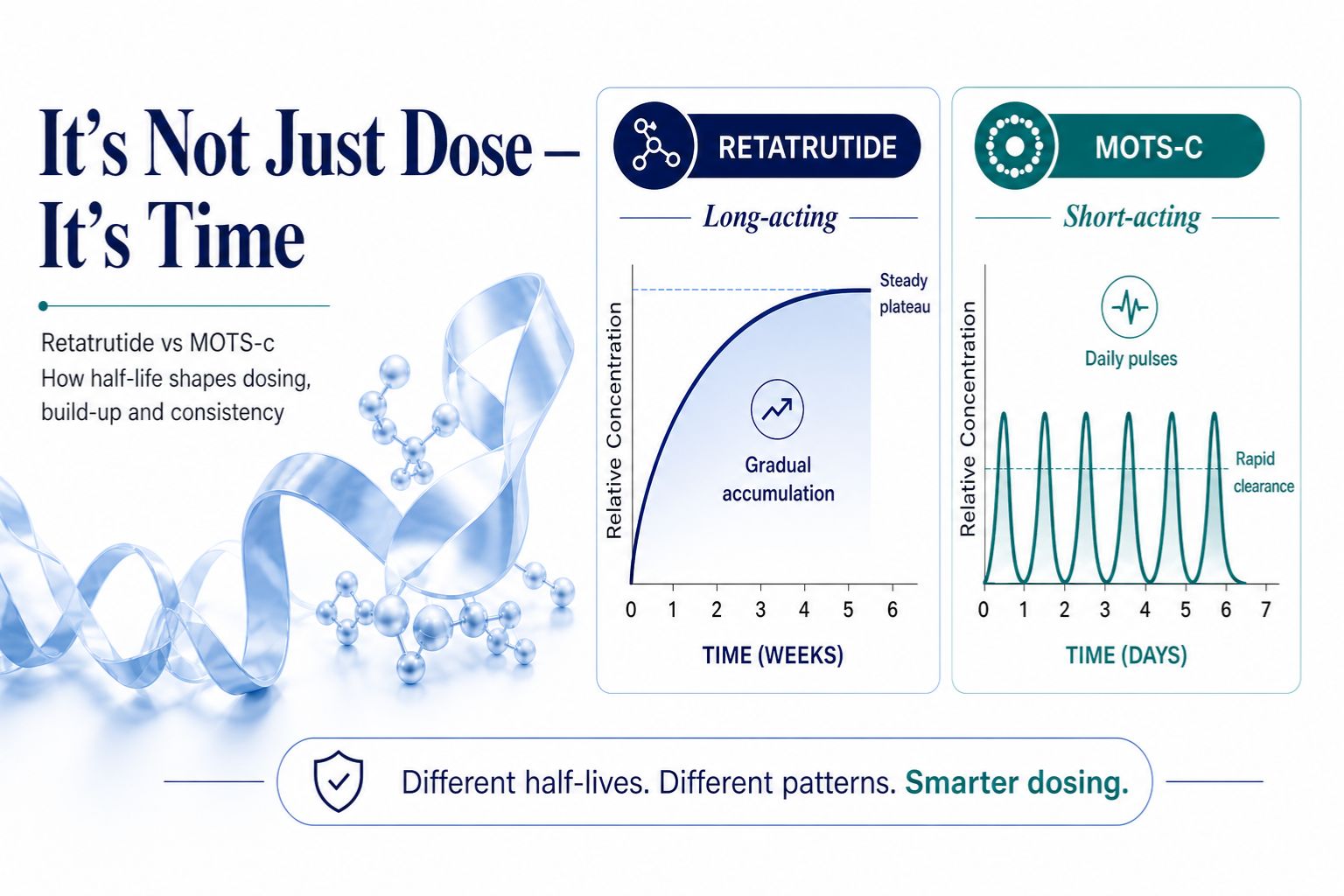
Retatrutide is a longer-acting, hormonally active peptide where the effect emerges through gradual accumulation toward a stable working level. MOTS-c behaves more like a shorter-acting metabolic signal, where the benefit comes from repeated daily pulses rather than long-term build-up.
The deeper principle is simple:
A peptide’s dosing pattern is not arbitrary — it reflects how that compound behaves in the body.
Half-Life, Build-Up, and Stable Levels
Half-life is the time it takes for a compound to reduce by about 50% in the body. That determines how long a peptide remains active after it is taken.
When a peptide has a longer half-life, a meaningful portion of each dose is still present when the next dose is given. This causes accumulation. Each dose layers on top of what remains from the previous one, gradually raising the active baseline.
Over time, the amount being added begins to roughly match the amount being cleared. This is the point of stable levels, or steady state. At that stage, signalling becomes more consistent and predictable.
Shorter-acting peptides behave differently. Because they clear faster, they do not accumulate to the same extent. Their effect depends less on layering and more on repetition. That is why they are often used daily.
This is the real reason some peptides are dosed weekly while others are dosed daily.
Retatrutide — Long Half-Life, Accumulation-Driven
Setup
- Cartridge: 30 mg / 2 mL
- Concentration: 0.15 mg per click
- Dosing: weekly
- Working model: based on an approximate 7-day half-life
Escalation model
| Week | Clicks | Dose (mg) |
|---|---|---|
| 1 | 10 | 1.5 |
| 2 | 20 | 3.0 |
| 3 | 40 | 6.0 |
| 4 | 50 | 7.5 |
| 5+ | 50 | 7.5 |
Accumulated active level
Using a simplified model based on an approximate 7-day half-life
| Week | New Dose | Carryover | Total Active |
|---|---|---|---|
| 1 | 1.5 | 0 | 1.5 |
| 2 | 3.0 | 0.75 | 3.75 |
| 3 | 6.0 | 2.25 | 8.25 |
| 4 | 7.5 | 5.25 | 12.75 |
| 5 | 7.5 | 6.4 | 13.9 |
| 6 | 7.5 | 7.0 | ~14.5 |
| 7+ | 7.5 | ~7.5 | ~15 |
Interpretation
By Week 4, active levels have already risen well beyond the current week’s dose.
By Week 6, the compound is close to stabilising.
That means the effect is not being driven by the most recent injection alone. It is being driven by the total accumulated active level in the body.
This explains why:
- the early weeks can feel underwhelming
- results may seem to appear suddenly after a delay
- signalling often becomes more consistent without needing further escalation
Retatrutide is therefore accumulation-driven.
MOTS-c — Shorter Half-Life, Repetition-Driven
Setup
- Cartridge: 10 mg / 3 mL
- Total clicks: 300
- Dose: 15 clicks daily ≈ 0.5 mg
Daily pattern
| Day | New Dose | Remaining | Total Active |
|---|---|---|---|
| 1 | 0.5 | 0 | 0.5 |
| 2 | 0.5 | 0.1–0.2 | ~0.6–0.7 |
| 3 | 0.5 | 0.2–0.3 | ~0.7–0.8 |
| 4 | 0.5 | 0.2–0.3 | ~0.7–0.8 |
| 5+ | 0.5 daily | minimal carryover | stable pulse pattern |
Interpretation
MOTS-c does not rely on major accumulation. Its effect is created through repeated daily signalling.
Each dose produces a short-lived effect. Consistency comes from frequency, not from a large rising baseline. Missing doses reduces the overall signalling pattern more directly than it would with a long-acting peptide.
That means MOTS-c is repetition-driven.
Why Results Can Lag
With a longer-acting peptide like Retatrutide:
- early doses are still building toward an effective level
- the working effect becomes more obvious once enough accumulation has occurred
With a shorter-acting peptide like MOTS-c:
- the effect depends on regular daily exposure
- inconsistent use weakens the signalling pattern
So in both cases, early feedback needs to be interpreted in the context of time, not just dose.
Summary: How to Think About Peptide Dosing
Half-life determines dosing pattern
- Longer half-life = less frequent dosing
- Shorter half-life = more frequent dosing
Retatrutide
- long-acting
- builds over weeks
- each dose adds to what remains
- effect comes from accumulated level, not just the latest dose
- early weeks are often still below the working threshold
MOTS-c
- shorter-acting
- clears more quickly
- minimal accumulation
- effect depends on consistent daily exposure
- missed doses reduce signalling more directly
Accumulation vs repetition
- Retatrutide = accumulation-driven
- MOTS-c = repetition-driven
Why Retatrutide can feel delayed
- Week 1–2: building
- Week 3–4: approaching threshold
- Week 5+: stabilising
Why MOTS-c depends on consistency
- benefit is tied to frequency
- not long-term build-up
Practical takeaway
- do not judge long-acting peptides too early
- do not use short-acting peptides inconsistently
- match the dosing pattern to the peptide’s half-life
The effect you feel is not just what you took today — it is how that dose behaves over time.