
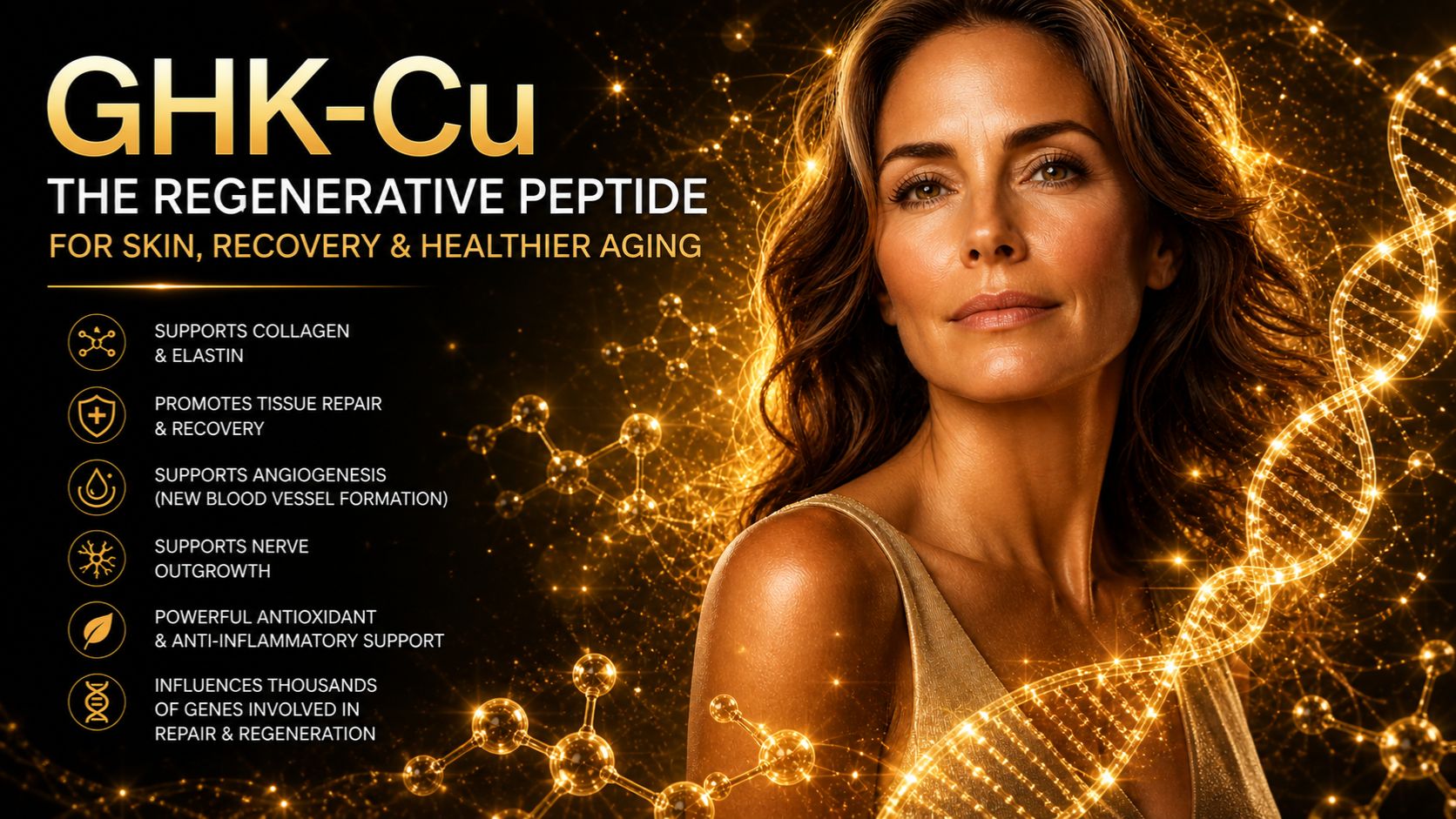
GHK-Cu is one of the most interesting peptides in the regenerative space because it appears to support far more than just skin appearance. This naturally occurring copper-binding tripeptide has been linked in review literature to collagen and elastin support, wound repair, connective tissue health, blood-vessel growth, nerve outgrowth, antioxidant protection, anti-inflammatory signalling, and broader repair-focused gene-expression patterns. That gives it a much stronger case than the average anti-aging ingredient.
If you are looking for a peptide that may support healthier-looking skin, better tissue quality, stronger repair signalling, and broader regenerative support as the body ages, GHK-Cu is worth serious attention. Its appeal is not that it does one narrow thing well. Its appeal is that it appears relevant to multiple repair and renewal systems at once.
The review article behind the interest in GHK-Cu
The paper most often referenced is “Regenerative and Protective Actions of the GHK-Cu Peptide in the Light of the New Gene Data”, published in 2018 in the International Journal of Molecular Sciences. This is a review article, not a single dramatic human trial, but it is important because it brings together earlier regenerative findings and gene-expression analysis to argue that GHK-Cu has unusually broad biological relevance.
That matters because it gives GHK-Cu a stronger scientific story than the average peptide trend.
The review links GHK-Cu to:
- collagen and elastin support
- wound repair and tissue remodelling
- blood-vessel growth
- nerve outgrowth
- antioxidant and anti-inflammatory effects
- gene-expression patterns associated with healthier repair and maintenance biology
So while the internet often overstates the science, the underlying takeaway is still powerful:
GHK-Cu appears to act across multiple regenerative systems at once.
Why people buy GHK-Cu
People buy GHK-Cu because they want more than a surface-level cosmetic effect.
They want support for:
- healthier-looking skin
- better tissue quality
- structural support beneath the skin
- connective tissue resilience
- improved repair signalling
- broader healthy-aging support
That is exactly why GHK-Cu is so attractive. It appears to support the biology that helps tissue stay stronger, recover better, and age more gracefully.
1. GHK-Cu for skin quality and visible aging
One of the clearest reasons to buy GHK-Cu is its link to collagen, elastin, fibroblast activity, and extracellular matrix remodelling.
This matters because skin quality depends on more than moisture or surface texture. It depends on the structural proteins and support systems underneath the skin itself. GHK-Cu has been linked to the biology that helps support firmness, elasticity, resilience, and healthier skin behaviour over time.
That makes it highly attractive for anyone who wants support for:
- skin texture
- firmness
- elasticity
- visible aging
- better overall skin quality
2. GHK-Cu for tissue repair and recovery
GHK-Cu is also worth buying because it is repeatedly associated with wound-healing and tissue-repair biology.
That gives it value beyond aesthetics. It makes it relevant for people interested in:
- recovery support
- tissue remodelling
- healing biology
- structural tissue health
- broader regenerative wellness
This is one of the reasons GHK-Cu stands out. It is not only about appearance. It appears relevant to the actual repair environment itself.
3. GHK-Cu for connective tissue and structural support
Another strong reason to consider GHK-Cu is its relevance to connective tissue support.
As tissues age, resilience often starts to fade. Recovery can become slower, skin may feel thinner or less robust, and structural quality may decline. GHK-Cu appears relevant to the pathways that help maintain and support stronger tissue architecture, which is why it holds broader appeal than a simple beauty product.
For someone looking for a peptide that supports tissue quality and structural resilience, this is a major part of the case for buying it.
4. GHK-Cu for angiogenesis and blood-vessel support
GHK-Cu has also been linked to angiogenesis, which means the formation of new blood vessels. This matters because healthy repair depends on more than collagen alone. Tissues also need good blood supply, oxygen, nutrients, and circulation to heal and remodel properly. By supporting blood-vessel-related repair signalling, GHK-Cu becomes more relevant not only for skin quality, but for broader tissue recovery and regeneration.
This adds to the appeal of GHK-Cu as an all-round regenerative peptide rather than a narrow cosmetic ingredient.
5. GHK-Cu for nerve-growth and regenerative signalling
The same review also links GHK-Cu to nerve outgrowth and broader regenerative signalling. That is another reason the peptide stands out.
It suggests that GHK-Cu may help support the deeper biology of tissue renewal, not just surface appearance. That makes it especially appealing for people who want a peptide that feels more complete — one that may support recovery, tissue quality, and healthier function at the same time.
6. GHK-Cu for anti-inflammatory and protective support
GHK-Cu is also discussed in the review literature in relation to anti-inflammatory, antioxidant, and protective signalling.
That is important because tissues do not recover well when inflammation stays excessive or poorly regulated. A healthier repair environment is not only about building new tissue. It is also about reducing the biological drag that slows good recovery down. This gives GHK-Cu a broader healthy-aging and recovery-support role, which makes it even more attractive as a purchase.
What the “4,000 genes” claim really tells us
One of the most dramatic claims around GHK-Cu is that it influences around 4,000 human genes.
The useful way to understand that is not as a miracle DNA rewrite, but as a sign that GHK-Cu may have broad biological influence across pathways related to:
- repair
- protection
- structural support
- inflammation control
- tissue maintenance
That is still highly impressive. It suggests that GHK-Cu may help support multiple regenerative systems at once, which is exactly why it is so attractive to people looking for a more complete peptide.
Why GHK-Cu is worth buying
GHK-Cu is worth buying because it appears to support more than one outcome at a time.
It is relevant to:
- skin quality
- collagen and elastin biology
- wound healing
- tissue remodelling
- connective tissue resilience
- blood-vessel support
- nerve-growth-related signalling
- inflammatory balance
- broader regenerative wellness
That makes it appealing for someone who wants a peptide built around repair, renewal, tissue quality, and healthier aging support rather than just cosmetic marketing language.
In simple terms:
GHK-Cu is worth buying because it appears to support the biology of regeneration, not just the appearance of youth.
Summary
GHK-Cu has become popular for good reason.
The review literature supports interest in it for:
- collagen and elastin support
- skin quality
- wound healing and tissue repair
- connective tissue resilience
- angiogenesis, meaning new blood-vessel support
- nerve-growth-related biology
- antioxidant and anti-inflammatory signalling
- broader repair-focused gene-expression patterns
That makes it a strong option for people who want an all-round regenerative peptide with benefits that go well beyond appearance alone.
Sources
- Pickart L, Margolina A. Regenerative and Protective Actions of the GHK-Cu Peptide in the Light of the New Gene Data. International Journal of Molecular Sciences. 2018. DOI: 10.3390/ijms19071987.
- Pickart L, Vasquez-Soltero JM, Margolina A. GHK Peptide as a Natural Modulator of Multiple Cellular Pathways in Skin Regeneration. BioMed Research International. 2015.
- Local and Systemic Peptide Therapies for Soft Tissue Regeneration: A Narrative Review. Review discussion of GHK-Cu in wound healing, collagen synthesis, fibroblast support, blood-vessel and nerve outgrowth.