
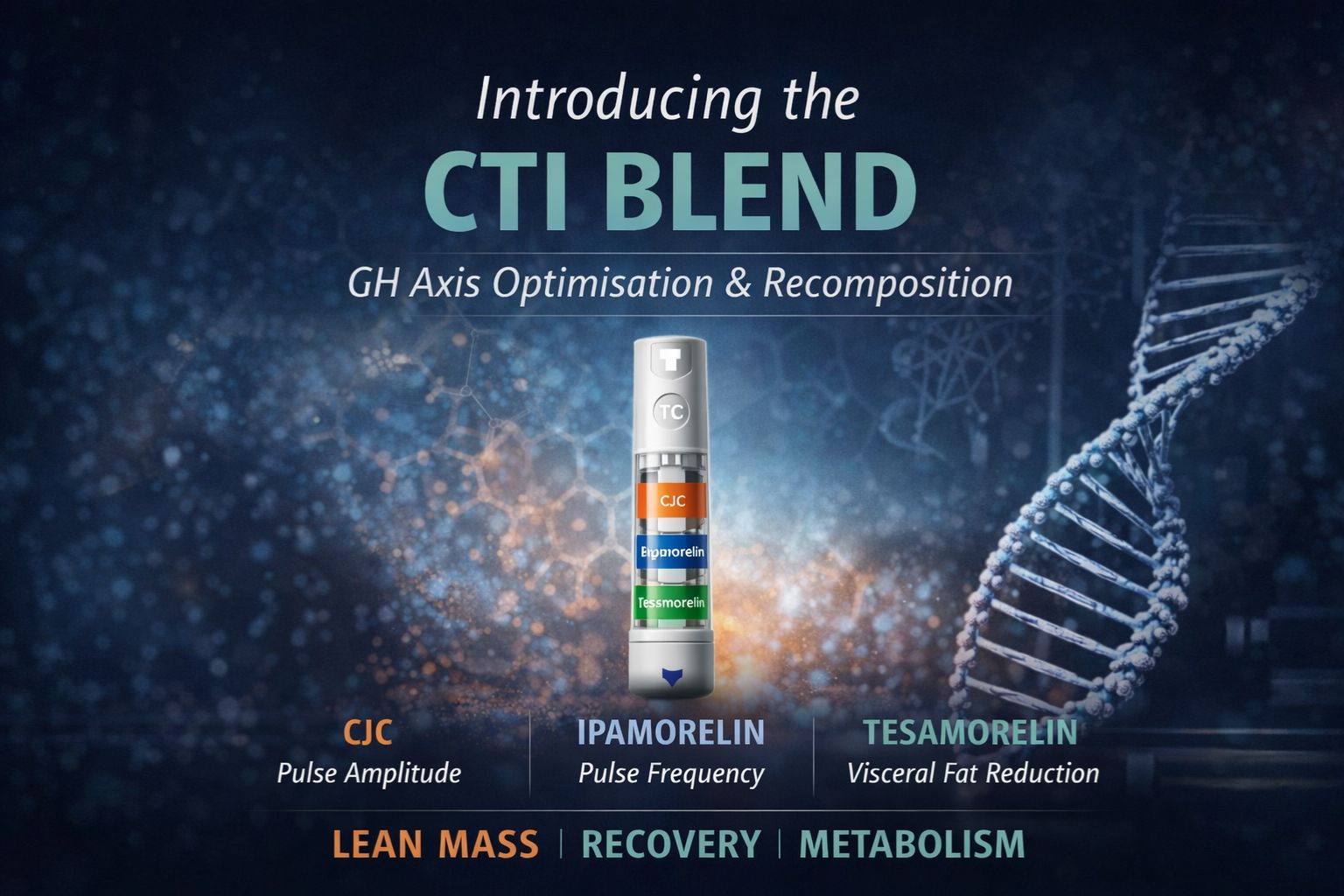
Growth hormone optimisation has evolved! What was once approached through single agent protocols is now increasingly viewed through a systems lens. Rather than stimulating one pathway in isolation, modern strategies focus on coordinated signalling within the growth hormone axis.
The CTI Blend represents this shift.
By combining CJC, Tesamorelin, and Ipamorelin in a structured ratio, CTI is designed to support endogenous growth hormone release through complementary mechanisms. It is not positioned as a shortcut. It is a structured tool for those seeking recovery optimisation, visceral fat refinement, and body recomposition support.
Understanding how it works requires understanding the axis it targets.
The Growth Hormone Axis: Why Balance Matters
Growth hormone secretion is naturally pulsatile. It is not constant. The pituitary releases GH in bursts, influenced by:
- Growth hormone releasing hormone signalling
- Ghrelin receptor activation
- Sleep cycles
- Insulin levels
- Stress
Traditional approaches often focus on stimulating one side of this system. However, imbalanced stimulation can produce diminishing returns or unwanted side effects.
A more refined strategy supports both amplitude and frequency of natural pulses while preserving physiological rhythm.
This is where CTI differentiates itself.
What Is the CTI Blend
CTI combines:
- CJC
- Tesamorelin
- Ipamorelin
In a 3:3:6 mg ratio within a precision pen system.
This 1:1:2 structure is intentional.
CJC and Tesamorelin act on the growth hormone releasing hormone pathway, influencing pulse amplitude. Ipamorelin works through ghrelin receptor signalling, influencing pulse frequency.
Together, they create coordinated stimulation rather than isolated activation.
CJC: Supporting Pulse Amplitude
CJC is commonly used to enhance growth hormone pulse amplitude. It supports the body’s own signalling cascade rather than replacing growth hormone directly.
Its role within CTI is foundational. By supporting stronger endogenous pulses, it contributes to:
- Recovery support
- Lean tissue maintenance
- Sleep related GH release
CJC works best when paired with complementary stimulation, which is why it is rarely used alone in advanced protocols.
Tesamorelin: Targeted Visceral Fat Focus
Tesamorelin is clinically studied for its impact on visceral adipose tissue.
Visceral fat behaves differently from subcutaneous fat. It is metabolically active and closely tied to insulin sensitivity and inflammatory markers.
Tesamorelin influences growth hormone release in a way that has demonstrated measurable changes in abdominal fat distribution in clinical settings.
Within CTI, Tesamorelin reinforces amplitude signalling while providing a more targeted metabolic emphasis.
This makes the blend particularly relevant in recomposition phases where central fat reduction is a priority.
Ipamorelin: Frequency Without Excess Spillover
Ipamorelin works through ghrelin receptor activation, supporting growth hormone release without significant cortisol or prolactin elevation when compared to earlier generation GHRPs.
Its function is to enhance pulse frequency.
This complements CJC and Tesamorelin, which influence pulse amplitude.
In simple terms:
- Amplitude determines how strong the pulse is.
- Frequency determines how often it occurs.
CTI addresses both.
Why Structured Blending Matters
Single compound protocols can work, but they often lack balance.
Too much amplitude stimulation without frequency support can limit responsiveness.
Too much frequency stimulation without amplitude enhancement may create weaker pulses.
The CTI structure aims to avoid extremes.
It is designed for coordinated signalling that respects the physiology of the growth hormone axis rather than overwhelming it.
This approach aligns with modern optimisation philosophy: support the system, do not replace it.
CTI in a Recomposition Context
CTI is most often discussed in the context of recomposition rather than aggressive mass gain.
Recomposition focuses on:
- Preserving lean mass
- Reducing visceral fat
- Improving recovery
- Enhancing sleep quality
- Supporting metabolic efficiency
During calorie controlled phases, endogenous growth hormone support may assist with lean tissue preservation.
During maintenance phases, it may support recovery and training adaptation.
Importantly, CTI is not a substitute for resistance training or nutritional structure. It is a support tool within a broader strategy.
Sleep, Recovery and Hormonal Rhythm
Growth hormone release is closely tied to sleep cycles.
Deep sleep phases are associated with the largest endogenous GH pulses.
Optimisation protocols that ignore sleep quality often underperform.
By supporting physiological pulse signalling, CTI is commonly positioned as a recovery aligned tool rather than purely aesthetic.
Recovery drives adaptation. Adaptation drives recomposition.
This is the larger context.
Who May Consider CTI
CTI is often discussed among individuals who:
- Have plateaued with single compound protocols
- Are entering a structured recomposition phase
- Are over 35 and noticing reduced recovery capacity
- Are refining body composition after significant fat loss
- Prioritise sleep and recovery optimisation
It is not positioned as an entry level protocol for rapid transformation.
It is structured support for those already implementing disciplined training and nutrition.
Monitoring and Responsibility
Any protocol influencing growth hormone signalling should be approached responsibly.
Considerations may include:
- Monitoring IGF 1 levels in extended use
- Observing for water retention
- Adjusting strategy based on response
- Maintaining realistic expectations
The objective is refinement, not excess.
Overstimulation rarely produces better outcomes long term.
CTI and the Modern Optimisation Philosophy
The optimisation landscape is shifting.
The focus is moving away from single lever solutions and toward coordinated signalling strategies.
CTI reflects that evolution.
- Rather than replacing hormones, it supports the body’s own release patterns.
- Rather than pushing extremes, it aims for balance.
- Rather than short term spikes, it supports structured adaptation.
The Clinic Perspective
The CTI Blend represents a measured approach to growth hormone axis support.
By combining CJC, Tesamorelin, and Ipamorelin in a structured ratio, it seeks to enhance both amplitude and frequency of natural pulses.
Within a disciplined framework of training, sleep, and nutrition, it may support:
- Lean mass preservation
- Visceral fat refinement
- Recovery optimisation
- Metabolic stability
Recomposition is rarely dramatic.
It is incremental. It is structured. It is patient.
The CTI Blend is designed to align with that philosophy.