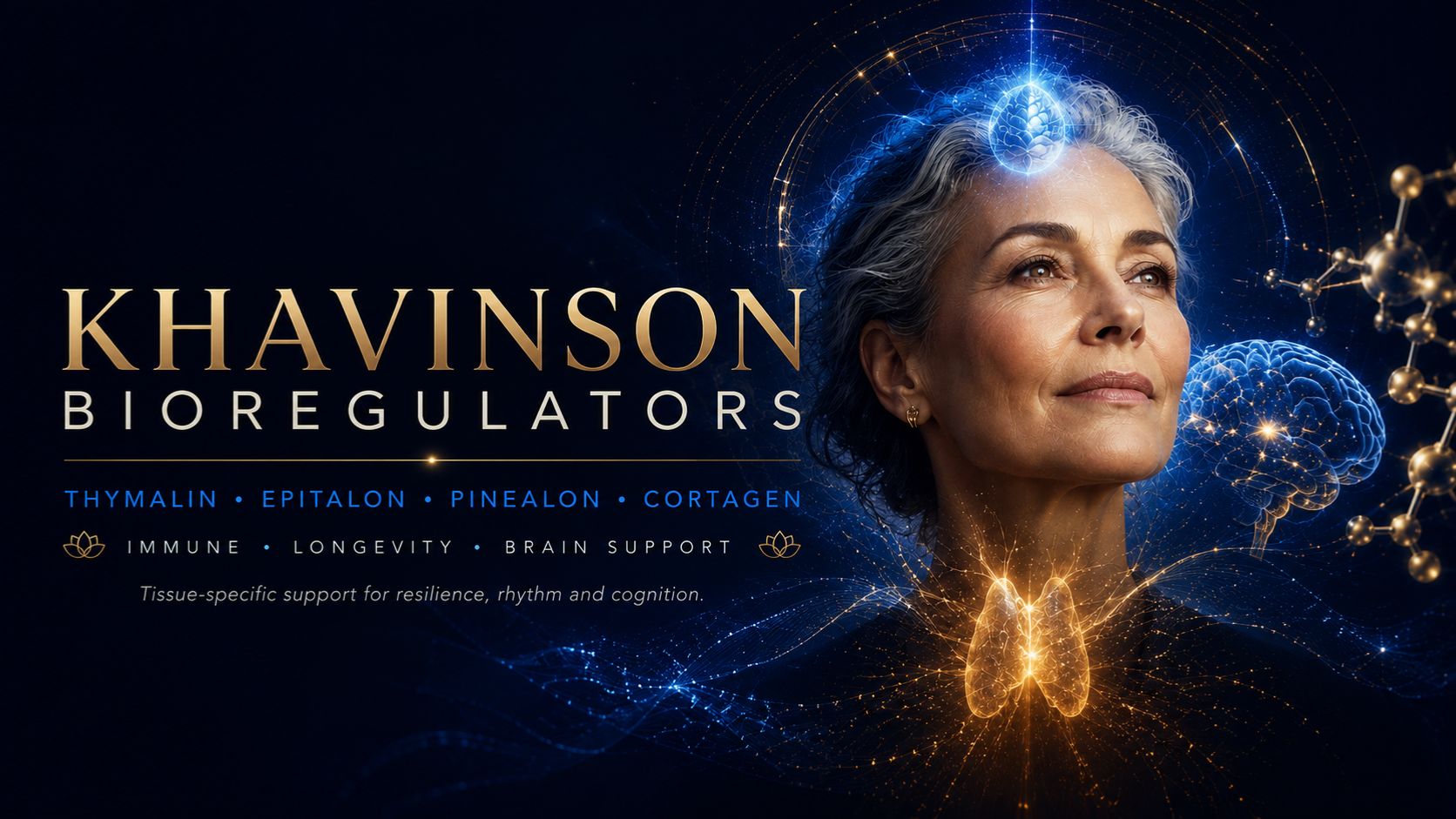
Khavinson bioregulators are often discussed together, but they are not interchangeable. That is the first thing to understand.
Thymalin, Epitalon, Pinealon, and Cortagen all belong to the same broader bioregulator tradition, but they are aimed at different systems, different priorities, and different use-cases. One leans more toward immune resilience and systemic recovery, one toward pineal signalling and longevity positioning, and two sit more naturally in the brain-support lane, with slightly different emphasis.
So the better question is not which one is best.
It is: which one fits the goal?
Who was Vladimir Khavinson?
Vladimir Khavinson was a Russian gerontologist and physician best known for his work on peptide bioregulators and aging research.
He became closely associated with the development and promotion of short peptide bioregulators aimed at supporting tissue-specific regulation, recovery, and healthy-aging biology. Over time, his name became especially linked to compounds such as Thymalin, Epitalon, Pinealon, and Cortagen, which are often grouped together under the broader Khavinson bioregulator framework.
That is why these peptides are often referred to collectively as Khavinson bioregulators. Whether someone is approaching them from an immune-support angle, a longevity angle, or a brain-support angle, the common thread is that they come out of the same broader research tradition built around peptide-based regulation rather than blunt stimulation.
What Khavinson bioregulators are
Khavinson bioregulators are short peptides or peptide complexes developed around the idea of supporting tissue-specific regulation rather than blunt stimulation.
That is why they are usually discussed in a healthy-aging, recovery, or restorative framework rather than as fast-acting performance agents. The appeal is that they are positioned to help support systems that often become less efficient with age, stress, or accumulated wear.
In practical terms:
- Thymalin is usually discussed around the immune and hematopoietic axis
- Epitalon is usually discussed around the pineal gland, circadian biology, and longevity signalling
- Pinealon is usually discussed around brain tissue, oxidative stress, and neuroprotection
- Cortagen is usually discussed around cortical support, cognition, and higher-brain function
That is the core logic behind how to use them.
Thymalin: for immune regulation, resilience, and recovery
If the main goal is resilience, recovery, immune support, or better regulation under physiological stress, Thymalin is usually the first one to look at.
The literature around Thymalin generally describes it as a thymus-derived peptide complex with immunomodulatory activity. It is the bioregulator most naturally positioned toward immune-cell signalling, broader resilience, and systemic recovery support.
When Thymalin fits best
- immune resilience
- systemic recovery
- recovery after stress or illness
- healthy aging where immune decline is a concern
- a broader restore-and-regulate approach rather than a purely cosmetic or performance-driven one
Best way to think about Thymalin
Thymalin is not the one to choose first for memory, brain sharpness, or sleep rhythm.
It is the one to consider when the question is:
How do I support the system that helps the body stay resilient and recover well?
Epitalon: for pineal signalling, sleep rhythm, and longevity positioning
If the main goal is circadian rhythm, sleep-related recovery quality, or a broader longevity-support narrative, then Epitalon is usually the bioregulator that stands out most.
Epitalon is a synthetic tetrapeptide derived from the epithalamic or pineal context and is commonly discussed for its relationship to pineal function, melatonin-related biology, and healthy-aging research.
It is also commonly brought into longevity discussions because of interest around telomerase, cellular aging, and broader recovery biology, though it should not be oversold as a literal anti-aging cure.
When Epitalon fits best
- sleep rhythm support
- better recovery quality through circadian support
- healthy-aging and longevity positioning
- a pineal, rhythm, and restoration focus
- stacking around nightly recovery and systemic aging support
Best way to think about Epitalon
Epitalon is the bioregulator to consider when the question is:
How do I support biological rhythm, sleep quality, and recovery as part of a longevity-focused strategy?
Pinealon: for neuroprotection, brain resilience, and cognitive support under stress
If the main goal is brain support, mental clarity, neuroprotection, or cognitive resilience under oxidative or physiological stress, Pinealon is one of the more natural fits.
Pinealon is generally positioned as a neuroprotective tripeptide, with relevance to oxidative-stress handling, neuronal support, and broader brain-aging resilience.
When Pinealon fits best
- neuroprotective support
- brain resilience
- oxidative-stress-related CNS support
- cognitive support where stress load is part of the picture
- healthier aging focused on protecting nervous-system function
Best way to think about Pinealon
Pinealon is the one to consider when the question is:
How do I support brain tissue and nervous-system resilience as stress and age accumulate?
Cortagen: for cortical support, cognition, and higher-brain function
If the main goal is memory, concentration, cortical support, or age-related cognitive decline positioning, then Cortagen is the next bioregulator to consider.
Cortagen is generally described as a cortex-derived bioregulator and is positioned more toward higher-brain support than immune or pineal regulation. This makes it especially relevant where the priority is mental sharpness, cortical function, and broader cognitive-aging support.
When Cortagen fits best
- memory support
- concentration
- cortical-function support
- higher-brain support
- cognitive-aging support
- a more cognition-led brain bioregulator approach
Best way to think about Cortagen
Cortagen is the one to consider when the question is:
How do I support higher-brain function, mental sharpness, and cortical resilience as the brain ages?
Pinealon vs Cortagen: the important distinction
This is where people often blur the categories.
Pinealon and Cortagen both sit in the brain-support family, but they do not read exactly the same.
Pinealon
Best framed as:
- neuroprotection
- oxidative-stress resilience
- brain-aging support
- protective support for the nervous system
Cortagen
Best framed as:
- cortical support
- memory and concentration
- higher-order brain function
- cognition-led support
So the cleaner editorial split is:
- Pinealon = the more protective, resilience-oriented brain bioregulator
- Cortagen = the more cortical-function and cognition-oriented brain bioregulator
That distinction makes the whole family easier to understand.
Mechanism differences: the simplest comparison
This is the easiest way to separate all four.
Thymalin
- immune and thymic regulation
- hematopoietic and immune-support relevance
- resilience and recovery emphasis
Epitalon
- pineal and circadian-related signalling
- sleep rhythm and recovery-quality emphasis
- broader longevity positioning
Pinealon
- brain and neuronal support
- oxidative-stress and neuroprotection angle
- nervous-system resilience emphasis
Cortagen
- cortical and higher-brain support
- memory, concentration, and cognition emphasis
- cognitive-aging positioning
So even though they all sit under the same umbrella, they are aimed at different biological priorities.
Which bioregulator fits which goal?
Here is the practical version.
Choose Thymalin when the goal is:
- immune support
- recovery and resilience
- systemic restoration
- healthy aging with an immune-regulation angle
Choose Epitalon when the goal is:
- sleep rhythm support
- pineal and circadian support
- better recovery quality
- longevity-focused positioning
Choose Pinealon when the goal is:
- neuroprotection
- nervous-system resilience
- oxidative-stress-related brain support
- broader brain-aging support
Choose Cortagen when the goal is:
- memory support
- concentration
- higher-brain support
- cognition-led brain-aging support
That is the cleanest way to use them.
Stacking logic
This is where the comparison becomes useful.
These peptides are not competitors. They can be stacked logically when the goal is broader support across multiple systems.
Thymalin + Epitalon
Best for:
- resilience plus longevity
- immune regulation plus sleep rhythm
- systemic recovery plus healthy-aging positioning
This is a strong stack when the goal is to support the body more broadly rather than chase one isolated effect.
Epitalon + Pinealon
Best for:
- rhythm plus neuroprotection
- sleep-related recovery plus brain resilience
- aging support focused on circadian and nervous-system support
This is the more protective brain-support pairing.
Epitalon + Cortagen
Best for:
- rhythm plus cognition
- sleep support plus higher-brain support
- aging support focused on clarity, concentration, and cortical function
This is the more cognition-led pairing.
Pinealon + Cortagen
Best for:
- neuroprotection plus cortical support
- brain resilience plus mental sharpness
- a more complete brain-support framework
This is the cleanest brain-focused stack if the goal is both protection and performance.
Thymalin + Pinealon
Best for:
- systemic resilience plus brain resilience
- recovery plus nervous-system support
- immune-aging support plus neuroprotection
This stack makes sense for someone who feels run down physically and mentally.
Thymalin + Epitalon + Pinealon + Cortagen
Best for:
- a broader longevity-support framework
- immune, pineal, neuroprotective, and cortical support together
- a more advanced full-spectrum bioregulator approach
This is the most comprehensive route, but it works best when the person has a clear reason for wanting broad systemic support rather than just starting somewhere.
Longevity positioning
The cleanest way to position these peptides in a longevity conversation is not to promise life extension.
It is to say they may help support some of the systems that tend to decline with age:
- immune regulation
- sleep and circadian recovery
- brain resilience
- cognitive sharpness
- oxidative-stress handling
- broader biological regulation
That is what makes them interesting.
Not because they are magic, but because they are aimed at important aging-related systems rather than one cosmetic surface outcome.
Summary
Thymalin, Epitalon, Pinealon, and Cortagen are not four versions of the same thing.
They fit different goals.
- Thymalin is the bioregulator to consider for immune support, resilience, and systemic recovery
- Epitalon is the one most aligned with pineal signalling, circadian rhythm, and longevity-focused support
- Pinealon is the more natural fit for neuroprotection, oxidative-stress resilience, and broader brain support
- Cortagen is the stronger fit for cortical support, memory, concentration, and cognition-led brain-aging support
That is why the real value is not choosing the best one in isolation.
It is matching the right bioregulator to the right goal, or using them together when the logic supports it.


