
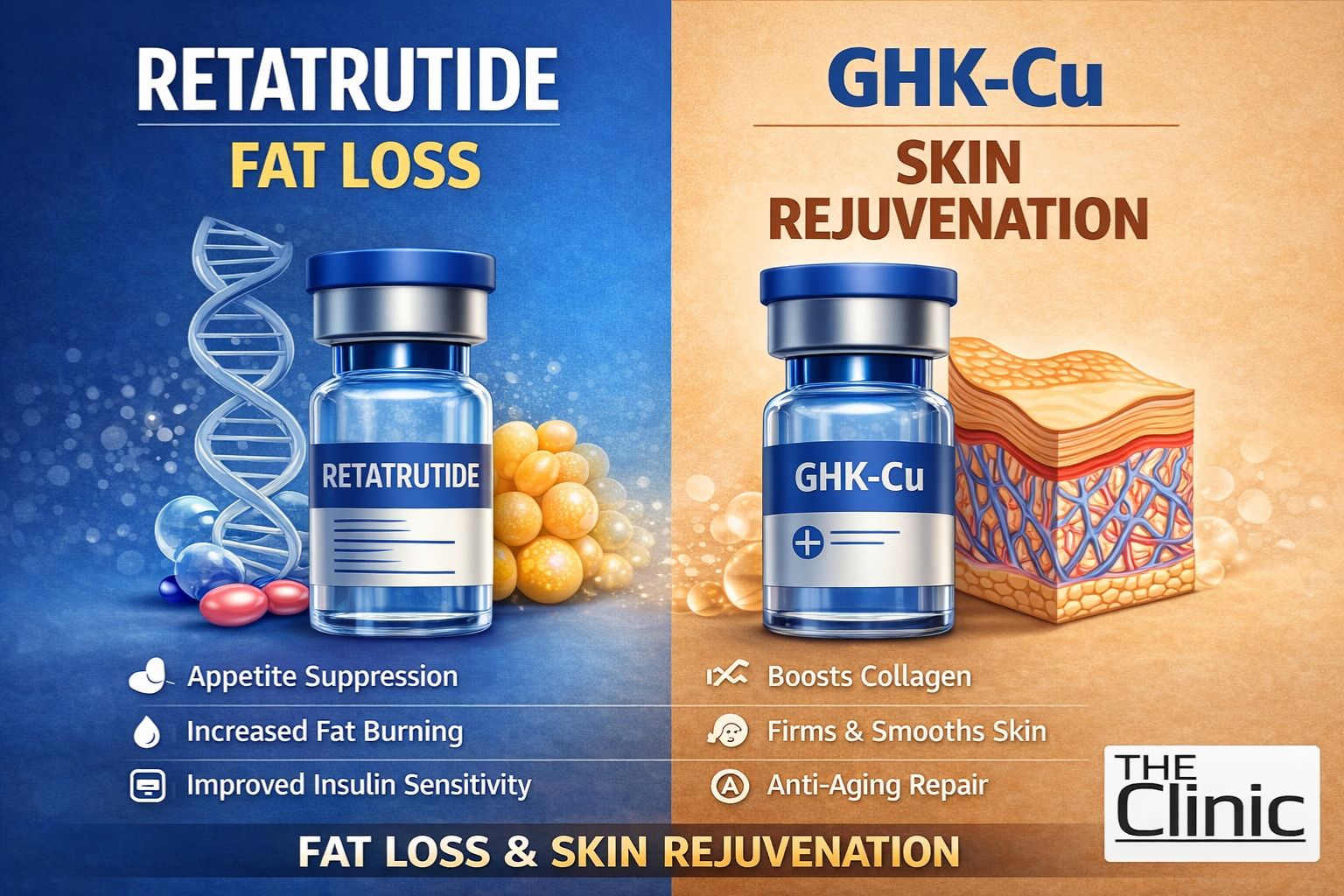
The landscape of peptide-based metabolic therapy is evolving rapidly. Weight loss is no longer viewed as a standalone goal. Instead, the focus has shifted toward intelligent body recomposition, reducing adipose tissue while preserving lean mass, structural integrity, and aesthetic quality.
One of the most promising emerging strategies combines Retatrutide, a next-generation triple incretin agonist, with GHK-Cu, a regenerative copper-binding tripeptide known for its collagen-stimulating properties.
This pairing addresses two critical dimensions of transformation: metabolic optimisation and dermal regeneration.
Understanding Retatrutide: Beyond Traditional GLP-1 Therapy
Retatrutide represents an evolution in incretin-based metabolic agents. Unlike single-pathway GLP-1 analogues, Retatrutide activates three receptors:
- GLP-1 (Glucagon-Like Peptide-1)
- GIP (Glucose-Dependent Insulinotropic Polypeptide)
- Glucagon receptors
This tri-agonist activity creates a broader and more dynamic metabolic response.
Metabolic Effects of Retatrutide
- Significant appetite suppression
- Reduced caloric intake
- Improved insulin sensitivity
- Enhanced fat oxidation
- Increased energy expenditure via glucagon signalling
- Reduction in visceral and subcutaneous adiposity
The addition of glucagon receptor activation is particularly important. While GLP-1 primarily reduces appetite and improves glycemic control, glucagon signalling may increase basal metabolic rate and promote fat utilisation. This dual mechanism allows Retatrutide to support both reduced intake and increased energy expenditure.
Clinical observations suggest substantial body fat reductions over sustained use, particularly in individuals with metabolic resistance or central adiposity.
The Aesthetic Challenge of Rapid Fat Loss
Rapid adipose reduction, especially when significant (>10kg), can present structural challenges:
- Loss of facial subcutaneous volume
- Skin laxity around abdomen and arms
- Reduced dermal density
- Accelerated appearance of fine lines
Fat tissue provides mechanical support to the skin. When it reduces quickly, collagen architecture must adapt. In aging individuals — particularly perimenopausal or post-40 populations — collagen production is already declining.
Without regenerative support, metabolic success may come at an aesthetic cost.
This is where GHK-Cu becomes strategically valuable.
GHK-Cu: A Regenerative Signalling Peptide
GHK-Cu (glycyl-L-histidyl-L-lysine copper complex) is a naturally occurring human peptide that binds copper ions and plays a role in tissue repair and regeneration.
Endogenous GHK levels decline significantly with age. Reduced levels are associated with decreased collagen synthesis, slower wound healing and reduced dermal resilience.
Mechanisms of Action
- Stimulates collagen types I and III synthesis
- Activates fibroblast proliferation
- Enhances glycosaminoglycan production
- Supports angiogenesis (microvascular formation)
- Modulates inflammatory cytokines
- Reduces oxidative stress signalling
Rather than acting as a surface-level tightening agent, GHK-Cu works at the gene-expression level, influencing regenerative pathways involved in extracellular matrix remodeling.
The result is improved skin thickness, elasticity and structural quality over time.
Why Retatrutide and GHK-Cu Work Synergistically
Fat loss and tissue regeneration are typically treated as separate domains. Combining Retatrutide and GHK-Cu creates a coordinated physiological strategy.
Retatrutide Contributes:
- Reduction of inflammatory adipose tissue
- Improved metabolic flexibility
- Lower circulating insulin levels
- Reduced systemic inflammatory burden
GHK-Cu Contributes:
- Enhanced collagen matrix production
- Dermal repair during volume reduction
- Improved tissue elasticity
- Regenerative support in a lower-inflammatory environment
As adipose tissue decreases, inflammatory mediators such as TNF-alpha and IL-6 typically decline. This creates a more favourable internal environment for regenerative signalling.
GHK-Cu performs optimally in such conditions, allowing collagen remodelling to occur without excessive inflammatory interference.
In practical terms, this means the body can reduce fat mass while simultaneously reinforcing the structural scaffolding of the skin.
Inflammation, Insulin and Skin Quality
Chronic hyperinsulinemia and adipose-driven inflammation accelerate collagen degradation and glycation. Advanced glycation end-products (AGEs) impair skin elasticity and contribute to visible aging.
By improving insulin sensitivity and reducing central adiposity, Retatrutide indirectly reduces glycation stress.
GHK-Cu further modulates oxidative signalling and supports extracellular matrix repair.
Together, these peptides address both upstream metabolic drivers and downstream structural consequences of aging.
GHK-Cu Subcutaneous Research Protocol
Typical research dosing:
- 1–2 mg daily
- OR 5 mg three to four times weekly
Cycle structure:
- 6–12 weeks active phase
- 4 weeks off for receptor reset
Subcutaneous administration allows systemic distribution, supporting not only facial skin but also abdominal, arm and thigh dermal adaptation during weight reduction.
Many protocols align GHK-Cu cycles with active fat loss phases to provide concurrent regenerative support.
Who Benefits Most from This Combination?
- Individuals losing significant body fat
- Patients concerned about GLP-1 related skin laxity
- Perimenopausal metabolic resistance cases
- Post-pregnancy recomposition
- Individuals over 35 undergoing rapid metabolic intervention
- Those prioritising both health markers and aesthetic preservation
This strategy is particularly valuable when weight loss goals exceed 10% of total body weight.
Metabolic Transformation Without Structural Compromise
Retatrutide represents one of the most advanced metabolic agents currently under investigation. GHK-Cu represents one of the most studied regenerative peptides in dermatological research.
Individually, each serves a powerful purpose. Together, they form a coordinated strategy:
- Reduce adipose tissue
- Improve insulin dynamics
- Lower systemic inflammation
- Stimulate collagen synthesis
- Preserve structural integrity during transformation
The goal is no longer simple weight loss. The goal is intelligent recomposition — metabolic improvement paired with structural preservation.
For those seeking both physiological optimisation and aesthetic refinement, the Retatrutide + GHK-Cu protocol represents a forward-thinking approach to modern peptide strategy.