
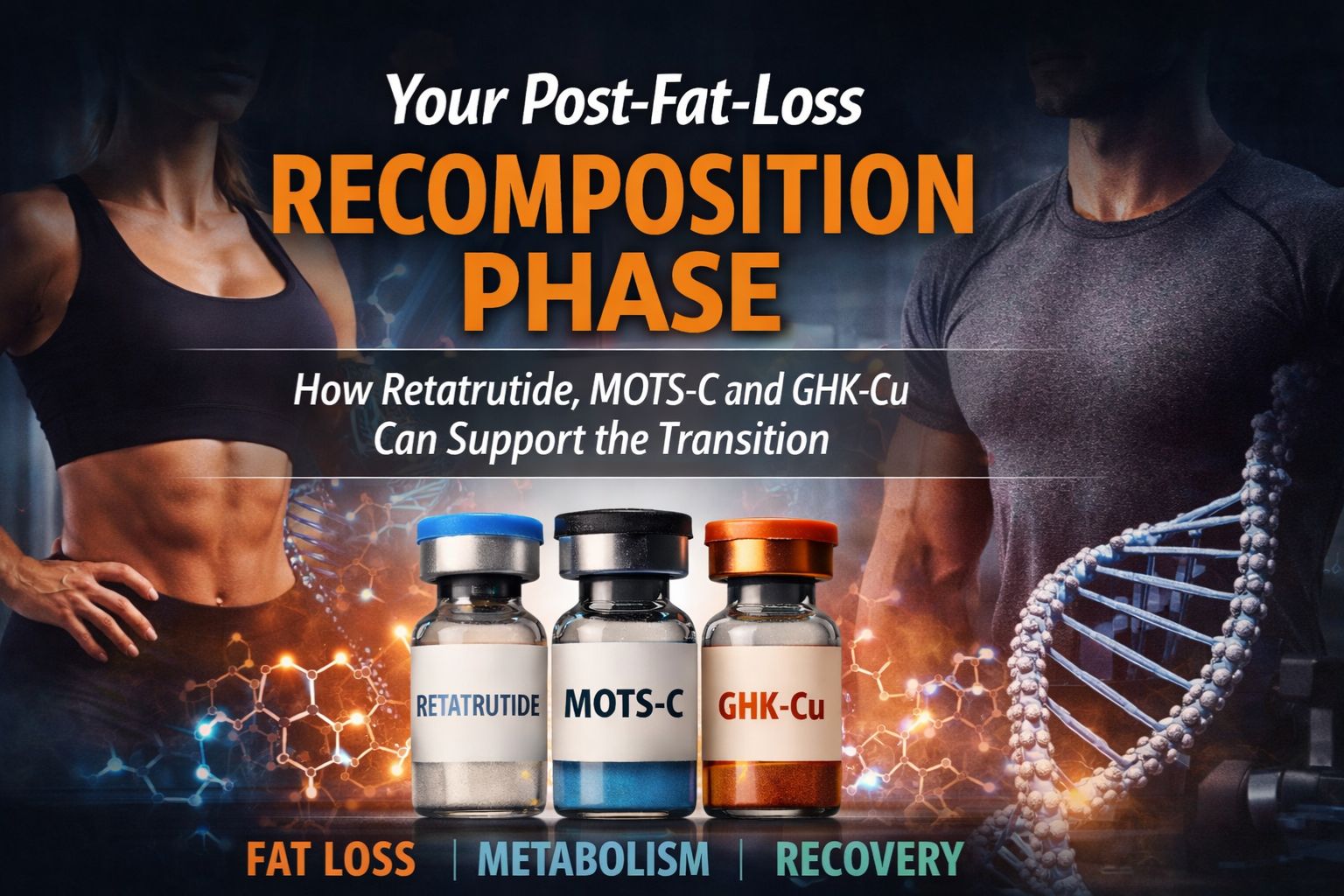
Losing body fat is an achievement. Maintaining it while improving muscle tone, metabolic resilience, and overall body composition is the real challenge.Many people focus intensely on the cutting phase. They reduce calories, increase activity, and use metabolic support tools to accelerate fat loss. But once significant weight reduction has occurred, the body enters a new phase.
- Metabolism adapts.
- Appetite signals shift.
- Training performance can decline.
This period, often overlooked, is where structured recomposition becomes critical.
Rather than continuing aggressive calorie restriction, our focus shifts toward:
- Preserving lean mass
- Preventing rebound weight gain
- Restoring metabolic flexibility
- Improving tissue recovery
In this context, Retatrutide, MOTS-C, and GHK-Cu are often discussed not as rapid fat loss tools, but as part of a broader metabolic strategy. Each plays a distinct role.
Retatrutide: From Fat Loss Driver to Metabolic Stabiliser
Retatrutide has gained attention for its multi pathway receptor activity influencing appetite regulation, insulin sensitivity, and energy balance.
During active fat loss phases, it may support:
- Reduced caloric intake
- Improved glycemic control
- Enhanced satiety
- Sustained weight reduction
However, once a significant amount of fat has been lost, the objective changes.
Continuing aggressive appetite suppression is not always desirable. Instead, the goal becomes metabolic stability, maintaining weight while gradually improving body composition.
In a post cut recomposition phase, Retatrutide may serve a different purpose:
- Helping prevent rebound overeating
- Supporting insulin sensitivity as calories increase
- Providing smoother transition from deficit to maintenance
This shift is crucial. Rapid withdrawal from appetite regulation tools after major fat loss can lead to compensatory hunger, increasing the risk of fat regain.
The goal is not more suppression, but controlled regulation while metabolism recalibrates.
The Hidden Challenge After Fat Loss
The human body adapts quickly to calorie restriction.
As body fat decreases:
- Resting metabolic rate may decline
- Thyroid output can shift
- Non exercise activity often subconsciously reduces
- Hormonal signals related to hunger increase
This is part of metabolic adaptation, a survival mechanism.
Without a strategic transition phase, many individuals regain fat rapidly after successful cutting.
True recomposition requires patience and structure.
MOTS-C: Supporting Metabolic Flexibility and Energy Efficiency
While Retatrutide primarily influences appetite and glucose control, MOTS-C operates at a different level, cellular energy signalling.
MOTS-C is associated with:
- Activation of AMPK pathways
- Improved glucose utilisation
- Enhanced fat oxidation
- Mitochondrial signalling support
After prolonged calorie restriction, metabolic flexibility can diminish. The body becomes less efficient at switching between fuel sources, and training intensity may suffer.
In a post fat loss phase, MOTS-C is often considered for its potential to:
- Improve nutrient partitioning
- Support endurance and training capacity
- Enhance cellular energy efficiency
- Counteract metabolic slowdown
Importantly, MOTS-C does not suppress appetite. Instead, it may help improve how the body utilises nutrients once caloric intake increases.
This makes it conceptually complementary to Retatrutide during transition phases. Where Retatrutide may stabilise appetite signals, MOTS-C may support metabolic recalibration.
The Recomposition Window: 8 to 12 Weeks That Matter
The weeks following significant fat loss are not a time to continue aggressive dieting.
Instead, this is a window for:
- Gradually increasing caloric intake
- Prioritising resistance training
- Protecting lean mass
- Monitoring body composition rather than scale weight
This is often referred to as reverse dieting or structured maintenance. The objective is refinement, not further dramatic reduction.
In this phase, Retatrutide may help smooth appetite variability. MOTS-C can support metabolic efficiency and training tolerance.
The combined philosophy is restraint and recalibration, not escalation.
Where Does GHK-Cu Fit
GHK-Cu operates in an entirely different category.
It is commonly associated with:
- Collagen support
- Tissue repair
- Skin quality
- Recovery signalling
Rapid or substantial fat loss can place stress on connective tissue and skin elasticity. Increased training volume during recomposition may also challenge recovery systems.
GHK-Cu is not a fat loss compound and does not influence appetite or metabolism directly.
Its potential relevance in a post cut phase lies in:
- Supporting tissue integrity
- Assisting recovery from increased training demand
- Enhancing skin appearance during body composition changes
For individuals concerned with aesthetic refinement after weight loss, this may be a supportive, not primary, consideration.
A Sustainable Recomposition Philosophy
The mistake many make after successful fat loss is continuing to chase lower scale numbers.
Body composition is not the same as body weight.
A sustainable recomposition strategy prioritises:
- Stable energy
- Strong training performance
- Preserved lean tissue
- Controlled caloric reintroduction
- Improved metabolic resilience
This phase requires discipline, but of a different kind. Instead of pushing harder, it requires strategic moderation.
- Retatrutide assist's appetite control during transition.
- MOTS-C supports cellular energy and metabolic flexibility.
- GHK-Cu assist's tissue recovery and aesthetic refinement.
None replace nutrition or resistance training. All are secondary to structured lifestyle foundations.
The Bigger Picture: Function Over Scale Weight
The ultimate question after fat loss is not: How much more can I lose?
It becomes: How efficiently can my body function at this new composition?
Recomposition is about efficiency. It is about improving how the body partitions nutrients, maintains muscle, and regulates appetite without extreme restriction.
When approached thoughtfully, the post fat loss phase can become the most transformative period. Not because weight drops further, but because composition improves while metabolic stability returns.
Our Thoughts
Fat loss phases are temporary by design. Recomposition is where long term results are secured.
The transition requires:
- Patience
- Structure
- Gradual caloric normalisation
- Training progression
- Strategic metabolic support as appropriate
Retatrutide, MOTS-C, and GHK-Cu each have distinct theoretical roles within this broader framework.
Used responsibly alongside structured nutrition and resistance training, the focus shifts from aggressive reduction to sustainable refinement. That is where lasting change is built.